Welcome!

Benvenuti in queste pagine dedicate ad arte e letteratura. Amelia Carolina Sparavigna

Wednesday, 9 April 2014

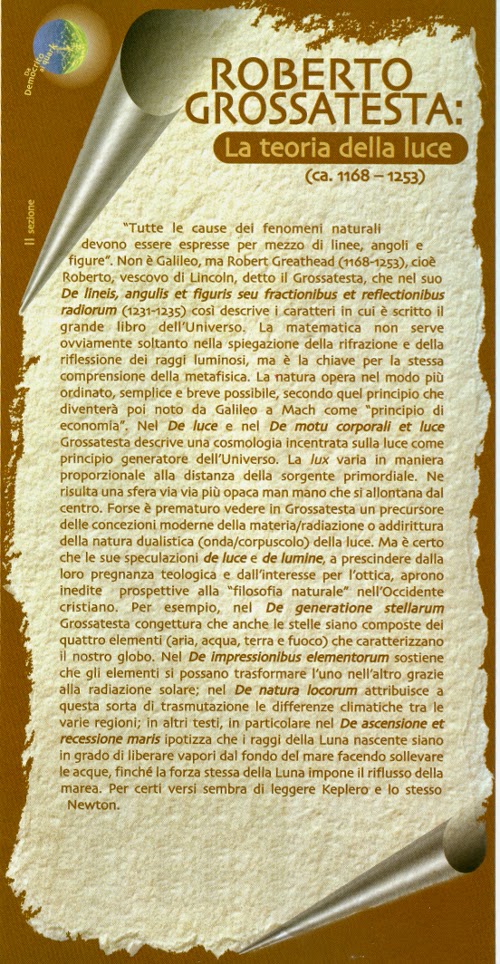
La teoria della luce di Grossatesta


estratto "Da Democrito ai quark, le grandi intuizioni della Fisica"
volume realizzato per il LXXXVII Congresso Nazionale della Società Italiana di Fisica

Sunday, 27 October 2013

An angel

"Leonardo da Vinci painted the most beautiful angels in the world. Since there are no actual angels, his pictures of them are literally the most real, the most gorgeous, the most magical that exist.
This is strange, because Leonardo was not a religious man. Although the National Gallery made a vivid case for him as a religious artist in its 2011 exhibition of his paintings, there is very little in his notebooks to suggest that Christianity was part of his everyday, personal life. Shopping lists are more prominent than prayers among his notes..."
Read more at "How Leonardo da Vinci's angels pointed the way to the future - The atheist innovator used religious commissions to test-drive his greatest invention – the flying machine"

http://www.theguardian.com/artanddesign/jonathanjonesblog/2012/dec/25/leonardo-da-vinci-angels-flying-machine


Thursday, 24 October 2013

A literary experiment on Harry Potter and his social network

Literary works can be analyzed in the framework of the network theories, as proposed for instance by the Stanford Literary Laboratory, in some of their experiments. The plot of a play or a novel, can be displayed as a network of interacting characters, where the timeline of the plot is projected on a planar graph. We can discuss this approach and apply it to the first novel of the Harry Potter series written by J.K. Rowling, entitled Harry Potter and the Philosopher's Stone. Besides being an entertaining application for teaching networks, this approach can help in highlighting some features of the plot structure.

More details at:
A.C. Sparavigna, On Social Networks in Plays and Novels, The International Jounral of Sciences, Volume 3, Issue 10, 2013, Pages: 20-25PDF

Wednesday, 2 October 2013

Il Graneri a Palazzo Madama

GRANERI, Giovanni Michele, da il Dizionario Biografico degli Italiani - Volume 58 (2002) , di Cristina Giudice http://www.treccani.it/enciclopedia/giovanni-michele-graneri_(Dizionario-Biografico)/

"GRANERI, Giovanni Michele. - Questo pittore attivo in Piemonte alla metà del XVIII secolo è probabilmente identificabile con Giovanni Michele Graneri, figlio di Giovanni Maria "lavoratore di stoffe" e della torinese Clara Maria Andriola, nato a Torino il 28 sett. 1708 e battezzato nella chiesa dei Ss. Simone e Giuda il 30 settembre. Le fonti settecentesche lo dicono allievo di Pietro Domenico Olivero, il più importante e famoso pittore di scene di genere a Torino, ... Come Olivero anche il G. si inserisce nel filone della pittura dei bamboccianti che a Torino era stata conosciuta attraverso l'opera sia di Jan Miel a metà Seicento sia con i quadri di altri pittori fiamminghi presenti nelle collezioni sabaude.... Le prime opere datate e firmate del G. sono del 1738, quattro tele con tipiche scene di genere: una Rissa, un Ciarlatano con saltimbanchi, una Venditrice di cacio e un Venditore di salsicce e carni. I quadri, noti oggi solo attraverso fotografie in bianco e nero, appartennero alla galleria di Pietro Accorsi a Torino. Al 1740 risale il Mercato in piazza del Municipio, tela nota anche come La punizione delle venditrici di uova marce (Torino, Museo civico d'arte antica). È una descrizione accurata di un fatto di cronaca che testimonia in modo vivace e minuzioso la vita quotidiana a Torino a metà Settecento, con gendarmi armati, abiti ricchi o popolari, insegne, edifici, banchetti con frutta e verdura. Il pittore si preoccupa, infatti, di rendere la reale vivacità del fatto con colori accesi e particolari divertenti, senza indugiare troppo sulle fisionomie delle figure, che sono simili tra loro. A differenza di Olivero, il G. non vuole meditare sulle vicende umane che descrive, ma divertirsi e rendere con ironia la vita che gli scorre intorno, esasperandone a volte certi aspetti fino alla loro deformazione. Nel Cavadenti, firmato e datato 1743, il G. costruisce un teatrino in cui il protagonista, vestito di rosso, mostra trionfante il dente estratto, il paziente risponde al dolore alzando il braccio, mentre l'assistente del cavadenti guarda con ammirazione e curiosità attraverso la maschera che gli copre il viso. In primo piano, a destra e a sinistra, sono gruppi di figure, che si ritrovano in altri dipinti del G., quasi presenze fisse sulla scena, e sullo sfondo altre immagini di venditori sotto un portico; la firma del pittore è posta su un quadro appeso a una parete, che illustra un uomo che armeggia con ampolle e alambicchi. ..."

Molti quadri del Graneri si trovano a Palazzo Madama, Torino.


Friday, 28 June 2013

Nosce te ipsum

"Il Gnôr Grassiadiô e il Gnôr Côlômbô erano due amici-nemici che, secondo la leggenda, abitarono per tempo immemorabile a fronte a fronte, sui due lati di uno stretto vicolo della città di Moncalvo. Il Gnôr Grassiadiô era massone e ricchissimo: si vergognava un poco di essere ebreo, ed aveva sposato una gôià, e cioè una cristiana, dai capelli biondi lunghi fino al suolo, che gli metteva le corna. Questa gôià, benché appunto gôià, si chiamava Magna Ausilia, il che indica un certo grado di accettazione da parte degli epigoni; era figlia di un capitano di mare, che aveva regalato al Gnôr Grassiadiô un grosso pappagallo di tutti i colori che veniva dalle Guyane, e diceva in latino "Conosci te stesso". Il Gnôr Côlômbò era povero e mazziniano: quando arrivò il pappagallo, si era comperata una cornacchia tutta spelacchiata e le aveva insegnato a parlare. Quando il pappagallo diceva "Nosce te ipsum" la cornacchia rispondeva "Fate furb", "fatti furbo"."
da Il Sistema Periodico, di Primo Levi
http://areeweb.polito.it/strutture/cemed/sistemaperiodico/s16/e16_1_02.html

Gnôr Grassiadiô and Gnôr Côlômbô were two friendly enemies who, according to the legend, had lived from time immemorial face to face on the two sides of an alleyway in the town of Moncalvo. Gnôr Grassiadiô was a Mason and very rich. He was a bit ashamed of being a Jew and had married a goyà, that is, a Christian, with blond hair so long it touched the ground, who cuckolded him. This goyà, although really a goyà, was called Magna Ausilia, which indicates a certain degree of acceptance on the part of the epigones; she was the daughter of a sea captain who had presented Gnôr Grassiadiô with a large, varicolored parrot which came from Guyana and would say in Latin, “Know thyself.” Gnôr Côlômbô was poor and a Mazzinian. When the parrot arrived he bought a crow without a feather on its back and taught it to speak. When the parrot croaked, “Nosce te ipsum,” the crow answered, “Wise up.“
Primo Levi - The Periodic Table
Translated from the Italian by Raymond Rosenthal

Monday, 17 June 2013

Festival Beethoven

Dal 24 al 30 giugno 2013, Piazza San Carlo

Le 9 Sinfonie con l’Orchestra Sinfonica Nazionale della RAI e il Coro del Teatro Regio. I Concerti con l’Orchestra Filarmonica di Torino e grandi interpreti.
Tutte le sere, ore 21, Ingresso libero


Immagine non-photorealistic rendering; vedi A.C. Sparavigna, B Montrucchio,  
Non-photorealistic image rendering with a labyrinthine tiling, http://arxiv.org/abs/cs/0609084


FESTIVAL BEETHOVEN

From 24th to 30th June in Piazza San Carlo, seven evenings of free classical music by the Orchestra Sinfonica Nazionale della RAI (RAI National Symphonic Orchestra) and Torino Philharmonic Orchestra.

Festival Beethoven. The RAI National Symphonic Orchestra will perform Beethoven’s Nine symphonies and Torino Philharmonic Orchestra, with young talents already nationally affirmed, four of five Concerts for the Piano, the Concert for Orchestra and Violins and the Triple Concert.


Friday, 1 March 2013

Karazuri - Ghost


Nishiki-e print with Karazuri; a work by Utagawa Toyokuni II (Toyoshige), 1825-1830, representing a ghost, Museo di Arte Orientale, Torino.


On Karazuri, read please
The Japanese art of using an inkless printing

Tuesday, 19 June 2012

Arles, Turin and Caesar

The heart of the ancient history of Arles, this is what is on show at the Louvre Museum of Paris, until 25 June 2012. The Museum is hosting an exhibition of spectacular Roman pieces recovered from the bottom of the Rhone! From March 9 to June 25, 2012, the Louvre Museum in Paris

On exhibition fifty of the most spectacular artifacts unearthed by archaeologists: columns and capitals, fragments of statues and reliefs, Roman jewelery, lamps, vases ... These pieces are coming from the museum of Arles, and other pieces from Avignon, Vienne and Turin.
Among the pieces from Turin, you can admire Julius Caesar's bust, unearthed in 1825, long considered unique, until the discovery in 2007 in Arles of another bust of the Roman politician. At the Louvre, these sculptures will be presented for the first time side by side.

http://www.france.fr/it/arti-e-cultura/evenement/arles-gli-scavi-del-rodano-un-fiume-memoria


Thursday, 14 June 2012

Blackwood and Lovecraft

Of such great powers or beings there may be conceivably a survival... a survival of a hugely remote period when... consciousness was manifested, perhaps, in shapes and forms long since withdrawn before the tide of advancing humanity... forms of which poetry and legend alone have caught a flying memory and called them gods, monsters, mythical beings of all sorts and kinds...

These words written by Algernon Blackwood introduce the The Call of Cthulhu, by H. P. Lovecraft.

"The most merciful thing in the world, I think, is the inability of the human mind to correlate all its contents. We live on a placid island of ignorance in the midst of black seas of infinity, and it was not meant that we should voyage far. The sciences, each straining in its own direction, have hitherto harmed us little; but some day the piecing together of dissociated knowledge will open up such terrifying vistas of reality, and of our frightful position therein, that we shall either go mad from the revelation or flee from the light into the peace and safety of a new dark age."

http://www.dagonbytes.com/thelibrary/lovecraft/thecallofcthulhu.htm

Tuesday, 6 December 2011

Raphael in Florence

I have proposed in the previous post "Raphael's portrait of Leonardo", that Raphael depicted in his fresco, the School of Athens, the philosopher Plato with the features of Leonardo. We can ask ourselves where and when Raphael met Leonardo. Probably in Florence around 1504, because in this place and years, both artists where working there, according to the book,  RAPHAEL, by  HENRY STRACHEY, LONDON, G. BELL & SONS, LTD., 1911


"Lo Sposalizio" in the Brera at Milan, may  be said to mark a further stage in Raphael's emancipation. It bears, on the temple in the background of the picture, the inscription, "Raphael Urbinas, M.D. IIII." 
Vasari's allusion to this picture seems to indicate that he considered this work to show that the young painter  was throwing off the trammels of Perugino. He says:" In this work the process of excellence may be distinctly traced in the manner of Raphael, which is here much refined, and greatly surpasses that of Pietro." ...  Somewhere about this time Raphael most likely went to Siena, for Vasari says that Pintoricchio,  who was about to paint in the Piccolomini Library, sent for Raphael to help him. There seems nothing unlikely in this story, and it would account for the drawing made from the antique group of the three graces, which was then at Siena, and which drawing Raphael used for the little picture of the " Graces," of  the Dudley collection. ... According to Vasari, Raphael left Siena on hearing of the great artistic stir then taking place in Florence, caused by the exhibition of Leonardo's and Michelangelo's cartoons for the decoration of a hall in the Palazzo Vecchio. It seems that Leonardo began to make preparations to paint in February 1505. This would accord with Vasari's story, and with the letter which the Duchess of Urbino wrote to the Gonfaloniere Soderini, recommending " The painter Raphael of Urbino." She says "The talent which he possesses has decided him to come to Florence for a time, to perfect himself in his art. His father was dear to me for his many excellent qualities, and I had not less affection for his son, who is a modest and agreeable 
young man, and one who will, I hope, make all possible progress." The letter is dated October 1, 1504. One cannot help being amused at the worthy Duchess's hope that the agreeable young man will make progress, when he was no other than the painter of " Lo Sposalizio." 
It is quite possible that Raphael may have been to Florence before this, as it seems clear that Perugino 
was in the habit of going backwards and forwards between the Tuscan capital and Perugia; and he may have taken Raphael with him. However, it is not until the visit which seems to have been made at the end of  the year 1504 that we can trace a stage in the development of the painter attributable to the influence of Florentine art. Raphael stayed in Florence from 1504 to 1508,  paying occasional visits to both Perugia and Urbino. At the former place he carried out two important works, the "Madonna di Sant Antonio" once in the South Kensington Museum, and the "Madonna Ansidei" in  the National Gallery. While in Florence he painted that wonderful series of Madonnas, beginning with the "Gran Duca" and " Terranuova" the full list of  which will be found in the chronological table given at the end of this volume. 

Friday, 2 December 2011

Raphael's portrait of Leonardo

Published as An image processing of a Raphael's portrait of Leonardo, by Amelia Carolina Sparavigna, Dipartimento di Fisica, Politecnico di Torino, http://arxiv.org/abs/1111.6030
Abstract: In one of his paintings, the School of Athens, Raphael is depicting Leonardo da Vinci as the philosopher Plato. Some image processing tools can help us in comparing this portrait with two Leonardo’s portraits, considered as self-portraits.

The "Scuola di Atene" is one of the most famous paintings by Raphael, the Italian Renaissance artist. Painted between 1510 and 1511, this fresco decorates the wall of one of the rooms, the "Stanza della Segnatura", in the Apostolic Palaces of Vatican. The great Greek philosophers are represented inside a classic architecture. At the central position of this masterpiece, we see two philosophers, Plato on the left and Aristotle, his student, on the right. Plato is shown as a wise-looking man (see Fig.1). It is believed that Raphael based the Plato's face on the features of Leonardo da Vinci [1]. The two artists probably had established a direct interaction when Raphael spent a period of his life in Florence, perhaps from about 1504 to 1508 [2-4]. Leonardo da Vinci returned to Florence from 1500 to 1506: therefore, if the image of Plato is a portrait of Leonardo, this means that Raphael depicted him when Leonardo was 52 or 54 year old.


Fig.1 Raphael’s Plato (image source:  http://www.aiwaz.net/)

There is a portrait in red chalk, dated approximately 1510 and held at the Biblioteca Reale of Turin, which is widely accepted as a self-portrait of Leonardo da Vinci. It is thought that Leonardo drew this self-portrait at the age of 58 or 60 (see Fig.2). Ref.5 tells that this well-known drawing is not universally accepted as a self-portrait, because the depicted face appears to be quite old, suggesting that Leonardo represented his father or grandfather. Another possibility is that Leonardo altered himself, in order that Raphael might use it for his Plato. However, Plato does not look so old in the painting by Raphael.


Fig.2 Leonardo’s portrait in red chalk (dated approx. 1510) held at the Biblioteca Reale of Turin.

In any case, let us try to find some matching points between the portraits, that of the man in red chalk (Fig.2) - let us call it from now on the self-portrait in red chalk – and the image of Plato (Fig.1) that Raphael had depicted in his fresco. To match the two faces, the image processing is fundamental: in particular, we will use another Leonardo's portrait merged with the self-portrait in red chalk. This portrait is a drawing of the Codex on the Flight of Birds, which Leonardo had partially hidden by his writing, as shown in Fig3, left panel. According to Carlo Pedretti, an Italian historian expert on the life and works of Leonardo, this is a self-portrait [6,7] made when the artist was young. The codex dated approximately 1505, but the portrait is older for sure: Leonardo recycled the paper for the composition of the Codex.
To use this portrait it is necessary to remove the written text. Carlo Pedretti was the first to suggest a “restoration” of this drawing, of course not of the real page of the Codex, but made on a photographic plate. It was only two years ago, in 2009, that Piero Angela, an Italian scientific journalist, presented the digital restoration of the portrait [8,9], that is, the restoration of the corresponding digital image. In 2009, I have proposed a simple approach that uses an iterative procedure based on thresholding and interpolation with nearest neighbouring pixels [10,11]. Recently, I proposed a further processing with a wavelet-filtering program, Iris [12-14]: the result is shown in Fig.3, right panel. According to Pedretti, this is the young Leonardo da Vinci self-portrait.


Fig.3. A page of the Codex on the Flight of Birds contains a Leonardo’s portrait. Using a digital restoration that removes the writing, the portrait appears.

For any comparison with the Raphael’s portrait, we have to complete this image, since the artist abandoned it unfinished. We use another processing tool, the GIMP [15], for this purpose. Using GIMP, we can add this drawing of the young man to the self-portrait in red chalk of the old man. The result is given in Fig.4: besides showing that the two faces have the same relative distances of eyes, nose and mouth, this portrait makes the old Leonardo look younger.


Fig.4 Using GIMP [15] we can add the portrait of the young man (Fig.3, right) to the self-portrait in red chalk (Fig.2) of the old man.

 Fig.5 On the right, the Raphael painting and on the left, the result of a merging of two Leonardo’s drawings

In Figure 5 we have the two images, the Raphael painting on the right and the result of merging the two Leonardo’s drawings on the left, shown side by side. Let me remark that we are looking at two images obtained from originals created by two artists who used different techniques and a different rendering of the head position. Moreover, there is another fact, which is in my opinion quite important, that the two portraits are showing a distinct side of the face. And we know very well that the two sides are not equal and that the existing small differences create the "good" and "bad" side of our faces [16].

Let us remember that for all the living creatures, the bilateral symmetry [17] of the body is an approximate symmetry: the two halves, left and right, of the body and then of the face, are not perfectly symmetrical. The symmetry of human faces is a subject of several studies. Some researchers are supporting the idea that more symmetry means more beauty and freedom from diseases [18-20]. On the other hand, a face, which is too symmetric, gives the impression of being unnatural [21].


Fig.6. Let us consider two canvasses, having on them a self-portrait and a portrait respectively, with the head depicted in the same position. The side of the face is different. When an artist is depicting a self-portrait, he is looking at the face in a mirror. Assuming the position of the head as above, the self-portrait is showing the left side of the face. In the case that it is another artist depicting the portrait, he is looking at the face directly, and then the side depicted is the right one.


The fact that the two sides are different is quite relevant if we are comparing a self-portrait with a portrait, because we must be sure to compare the same side of the face. For the explanation, let me use Fig.6. Let us consider two canvasses, having on them a self-portrait and a portrait, with the head depicted in the same position, the two paintings are showing a different side of the face. When the artist is depicting a self-portrait, he is looking at the face in a mirror. When it is another artist depicting the portrait, he is looking at the face directly. For this reason, if the face on the canvas has the same position, the depicted sides turn out to be different. Therefore, if the left image of Fig.5 is a self-portrait and the right image is a portrait, it is necessary to reflect one of then, to point out that we are seeing different sides.
I decided to change the Raphael’s image, with a reflection and a small rotation using GIMP. Moreover, I converted the colours in grey tones, to avoid the vision of different hues. Fig.7 gives the result. Is the figure showing the same person? I guess that there is this possibility, but further studies are necessary. Let me then avoid a direct answer and just write some conclusions.


Fig.7 Is this the same person?


Using the image processing we had compared portraits having quite different origins. This is telling that several processing tools, some of them freely available, can help in the study of history and arts. For what concerns the specific case, it seems from Fig.7, that the structure of the two faces, in particular of nose and cheekbones, is quite similar. We can also see that one of the eyes is a little bit larger in both images. According on the previous discussion on portrait and self-portrait (Fig.6), I tend to consider the Raphael’s Plato based on a direct interaction between Raphael and Leonardo, when Raphael was in Florence, and then on a previous portrait or drawing that Raphael made of Leonardo.


References
1. Raffaello Sanzio, presentato da M.G. Ciardi Dupré, Milano, Fratelli Fabbri Editore, 1963.
2. Cecil Gould, The Sixteenth Century Italian Schools, National Gallery Catalogues, London 1975.
3. Raphael, http://en.wikipedia.org/wiki/Raphael,
4. The School of Athens, http://en.wikipedia.org/wiki/The_School_of_Athens
5. Cultural depictions of Leonardo da Vinci,
http://en.wikipedia.org/wiki/Cultural_depictions_of_Leonardo_da_Vinci
6.. E. Crispino, C. Pedretti, C. Frost, Leonardo: Art and Science, Giunti, 2001.
7. C. Pedretti, A Chronology of Leonardo Da Vinci's Architectural Studies after 1500, E. Droz, Geneva, 1962.
8. ANSA.it - News in English - Leonardo self- portrait 'discovered', 2009 and also BBC NEWS Europe - 'Early Leonardo portrait' found, 2009.
9. http://www.leonardo3.net/
10. Amelia Carolina Sparavigna, 2009, The Digital Restoration of Da Vinci's Sketches, http://arxiv.org/abs/0903.1448
11. Amelia Carolina Sparavigna, 2009, Digital Restoration of Ancient Papyri,http://arxiv.org/abs/0903.5045
12. Amelia Carolina Sparavigna, 2011, A self-portrait of young Leonardo,http://arxiv.org/abs/1111.4654
13. Iris © 1999-2010, Christian Buil, http://www.astrosurf.com/buil/us/iris/iris.htm
14. Amelia Carolina Sparavigna, 2009, Enhancing the Google imagery using a wavelet filter, http://arxiv.org/abs/1009.1590
15. GIMP © 2001-2011, http://www.gimp.org/
16. I have read on the Glamour Magazine about a simple experiment by P. Gugliemetti, Do You Have A Good Side And Bad Side Of Your Face?, 11-13-2008. The author writes "At a party over the summer, I mentioned to someone how I have a good side and bad side, and she thought I was just being dramatic. So I had her take a photo of each side and we showed the shots to random people in the room, asking them to vote on which side was my prettier one. Every single person voted right! Then we tried this on other people, lining them up one-by-one against a white wall, shooting their sides, and having people vote. Only a couple had equally attractive sides."
17. Bilateral symmetry of a body means that there exists a plane which is dividing the body into two mirror image halves. An operation of reflection shows that the two halves coincide.
18. G. Rhodes and L.A. Zebrowitz, Facial Attractiveness - Evolutionary, Cognitive, and Social Perspectives. Ablex. ISBN 1567506364, 2002
19. R.J. Edler, Journal of Orthodontics Vol.28(2), pag.159, 2001
20. K. Grammer and R. Thornhill, Journal of Comparative Psychology, Vol. 108, pag.233, 1994.
21. R. Kowner, Journal of Experimental Psychology: Human Perception and Performance, Vol.22, pag.662, 1996.